Joshua Vides CS
How POP!NK connected the dots for Joshua Vides & Chicago’s Museum of Contemporary Art
The Project
Joshua Vides transforms reality into illusion. His pixelated, pop art-inspired paintings, murals and installations reimagine everyday objects and environments in vivid black and white, stripping them of dimension and depth — a world that is truly and unequivocally flat.
Vides burst into prominence via Instagram, wowing followers with his hyper-minimalist interpretations of everything from traffic cones to Modernica chairs to Nike Air Force 1s. Collaborations with brands including Converse, T-Mobile and Major League Baseball preceded 2020’s Forever Hallway, a multimedia installation presented by Chicago’s Museum of Contemporary Art. The heart of the exhibit, a series of ten window-themed canvases celebrating the Windy City’s iconic skyline, required Vides to rethink his achromatic aesthetic.
“Anytime we do any project, we try to do something new,” the Los Angeles-based artist and designer says. “I was playing with so many aspects and practices to pull off the cityscape with only white and black. Usually we paint the dots black, but it was too open — too easy to see the buildings. So we inverted the black dots for the first time.”
Vides extended Forever Hallway beyond the MCA’s walls by releasing an exclusive merchandise collection in partnership with the museum’s retail arm. The JV x MCA Essentials line featured graphic tees, hoodies, tote bags and water bottles alongside the pièce de résistance: a pair of limited-edition, Chicago skyline-inspired screenprints created in partnership with POP!NK Editions.
POP!NK was the obvious choice to translate Vides’ vision to paper. A year prior to Forever Hallway, Vides commissioned Chicago’s screenprinting sorcerers supreme to produce a set of hand-pulled prints commemorating his collaboration with Italian luxury fashion house Fendi.
“We always try to get into the heads of our artists, so we already knew what’s important to Josh, and what he thinks about when he’s making an image,” says POP!NK co-founder Curtis Readel. “We knew we could deliver a print that aligned with the Forever Hallway project’s specific goals, because we had delivered for Josh before.”
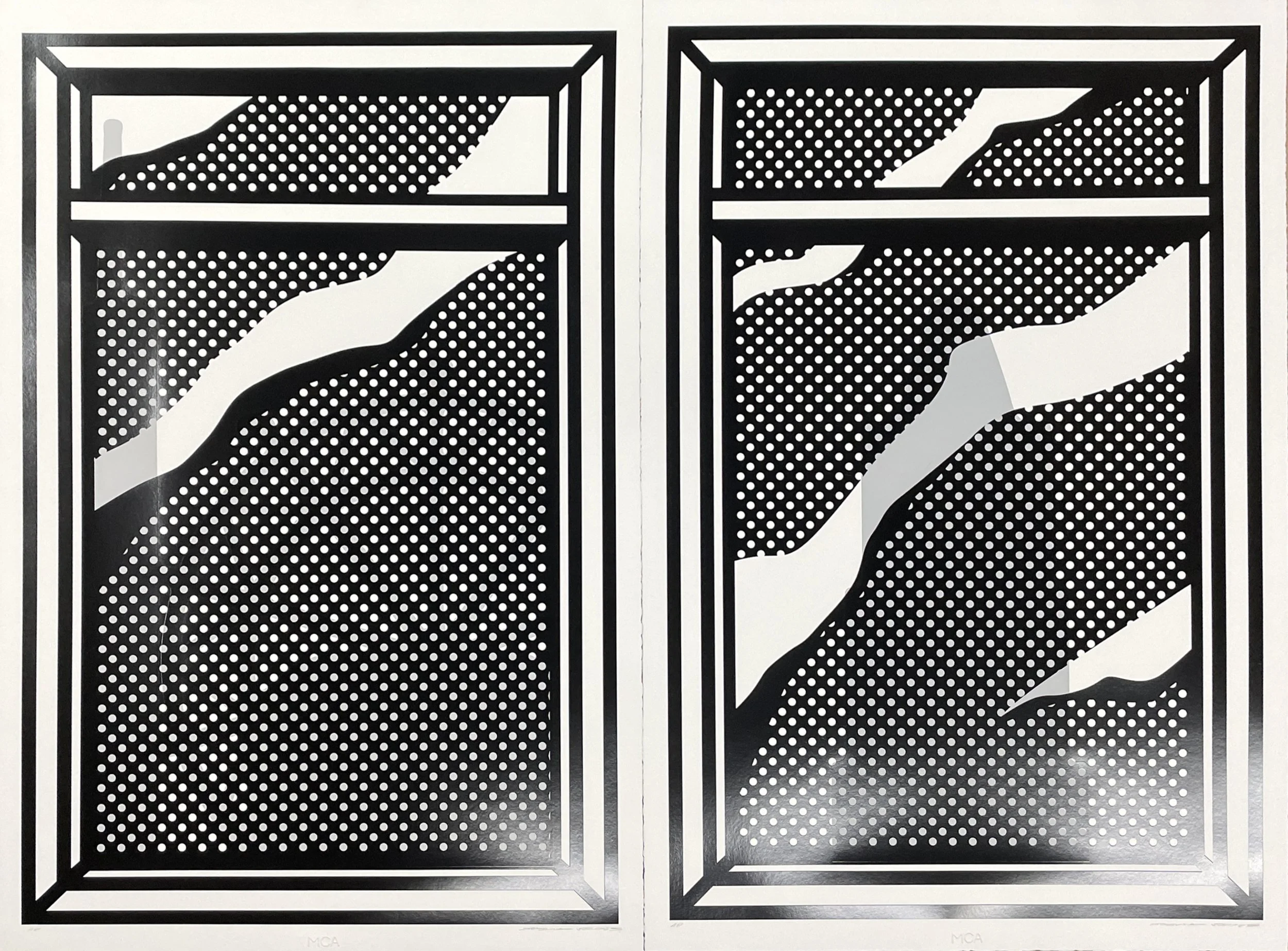
Completed MCA Window No. 1 print on left; completed MCA Window No. 2 print on right
The Process
Screenprinting leverages a blade or squeegee moved across a mesh to transfer ink onto a substrate (paper, for example), excluding any areas made impermeable by a blocking stencil. Colors are printed one at a time, necessitating a new screen for each additional layer of color the printer applies.
Both “Window no. 1” and “Window no. 2” feature just two layers, embellished with spot UV-gloss varnish.
“Josh’s approach often yields black areas with a high-gloss look to them,” Readel says. “To recreate this effect in the prints we created, we needed to enhance the flat matte look of our inks. Anytime you print gloss, it makes the colors underneath it richer, so doing a gloss over some but not all of the black gave us two additional tones. It perfectly mimics how his original work looks.”
Printing gloss can pose challenges, however. “Ink dries in five to ten minutes, but gloss is tacky for up to 24 hours. Not only can specks of dust and strands of hair drop in, but the gloss is statically charged, so printing it actually attracts those kinds of impurities,” Readel explains. “We have air filtration units going to lessen that impact, and we also set the gloss using an ultraviolet light, which dries it immediately.”
POP!NK evoked the immediacy and scale of the Forever Hallway viewing experience by printing both window-framed images on 36-by-24-inch Mohawk fine white paper.
“When Josh started out, he was doing smaller-format prints — 18 by 24 inches, mostly, although one of the very first prints he released was a light switch in his style, printed at the exact size of a standard light switch,” Readel recalls. “When it came time to do the Forever Hallway project, he asked us ‘What's the biggest that you can print?’ For Josh, this was very much about doing something bigger and better than anything he’d done before.”
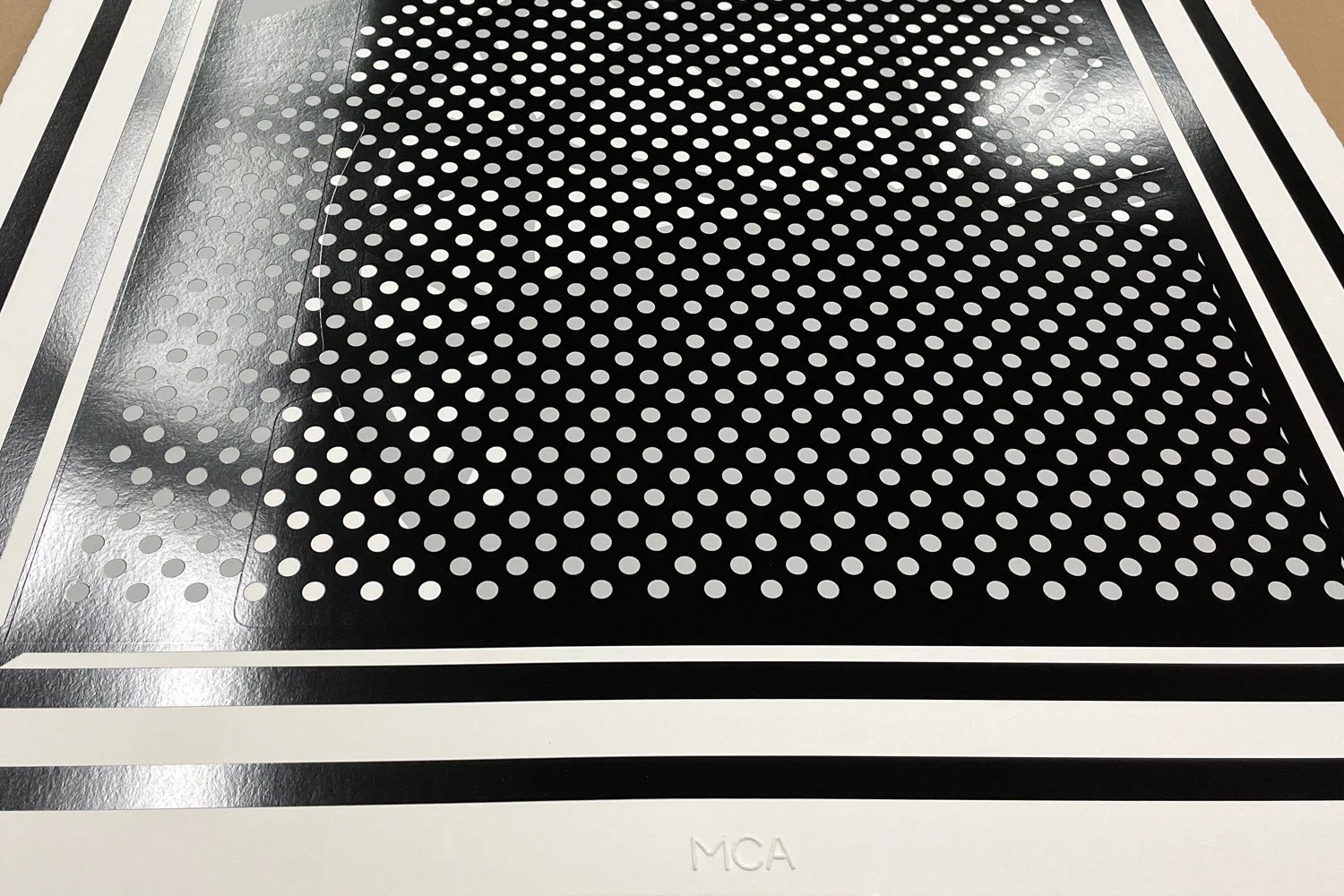
Detail of MCA Window No. 1
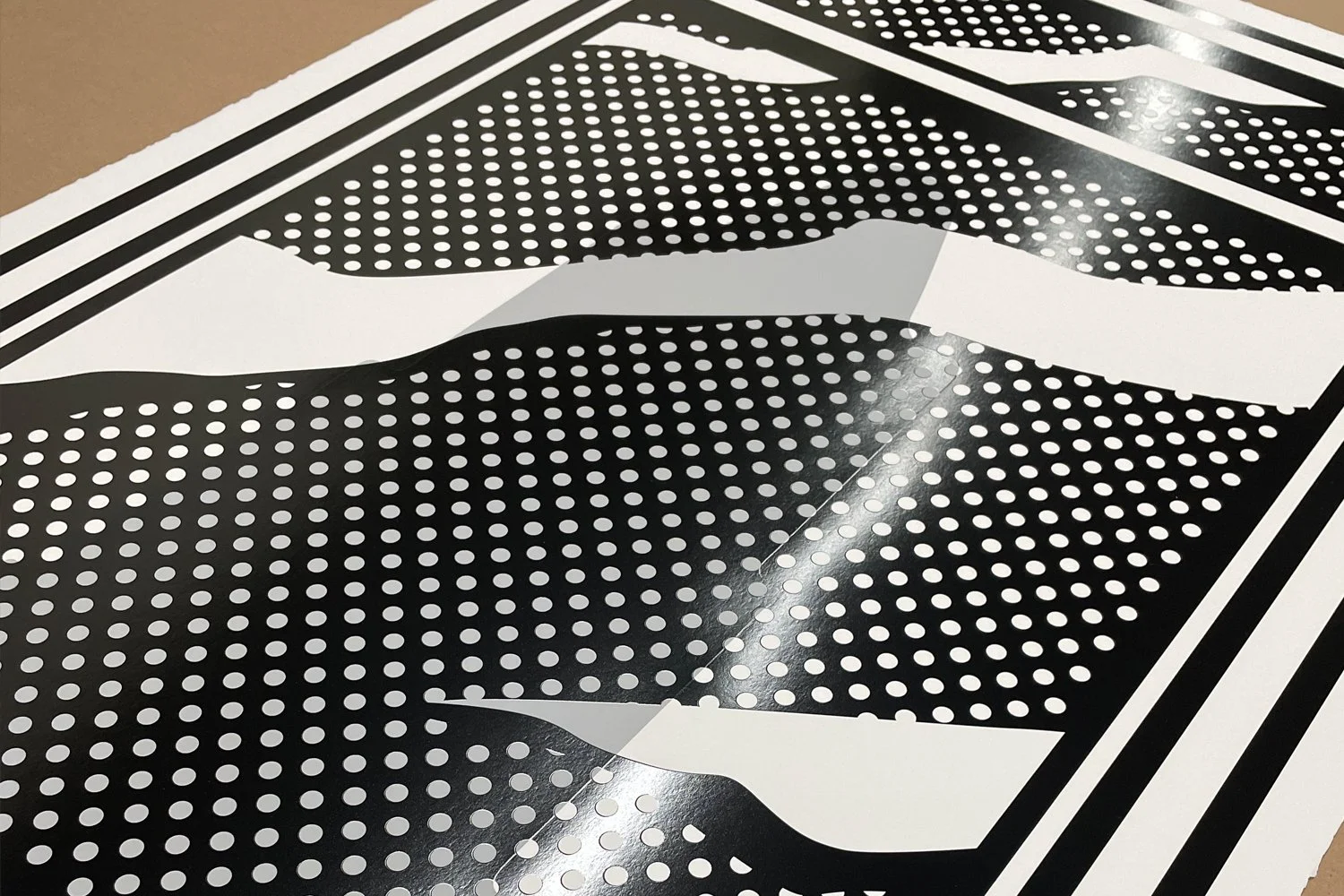
Detail of MCA Window No. 2
The Product
POP!NK worked directly with Vides at every stage of the printing process, ensuring “Window no. 1” and “Window no. 2” retained all the detail and character of the original Forever Hallway paintings. Vides signed all 200 numbered copies and 25 artist proof editions, and after the MCA imprinted its chop mark, the prints went on sale, with framed copies prominently displayed inside the museum’s Near North Side storefront. The entire run sold out before the installation closed.
“Framing the prints meant patrons could walk up to see the gloss, and at a distance, they could see the backgrounds, the landscape and the architectural features,” Readel says. “As a patron of the MCA, and as a collaborator with them and with Josh, it was fun seeing something that we had done in that setting. It felt like a kind of a reverence for the work we did — appreciation, too.”
The MCA wasn’t alone in its appreciation of POP!NK’s efforts.
“Giving people outside of [the museum’s] doors an opportunity to acquire a fine artwork means more to me than anything else,” Vides says. “That is what I [came to the MCA] to do.”